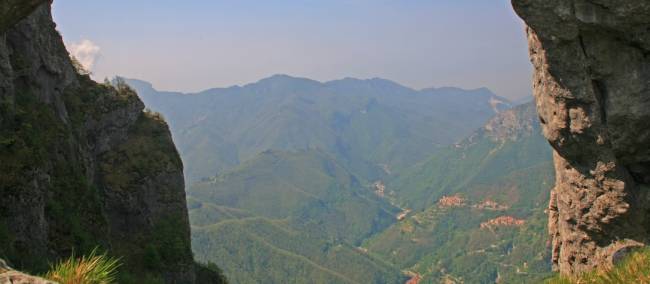
The Arch, Monte Forato | John Millen
Blog home / Local Resident Francesca on an Apuan Alps Hiking Experience
Walking in the Apuane Alps: A Local's Perspective
Hidden at the foot of the Apuan Alps in Tuscany is the teaching farm of Francesca and her family. Besides producing her own honey and olive oil, Francesca loves to explore the hidden paths of the Apuan Alps, walking the same woods and hills that generations before her have enjoyed for centuries. We asked her to share her secrets about the region and give us an insight into what a walking holiday in the Apuane Alps really involves.

Who are you and what is your connection to the Apuane Alps?
I am 58 and it was my father who taught me to love mountains. My family has always lived in areas surrounded by mountains, first the Appennino Tosco Emiliano and later the Alpi Apuane. I went out walking on his shoulders first, and when I got older, on my own legs. Today I love going out with my dogs. I really like to discover where each road or path goes, and to feel what the generations before me were thinking and doing when they walked the same routes. The history of the Apuan Alps goes far: first there were pre-Roman populations, followed by the Romans, then medieval and Renaissance people, then WWII soldiers (we are on the Gothic Line), and finally us today.
What makes the Apuane Alps National Park special?
The Apuane Alps are geologically young mountains, a kind of island rising out of the sea. There are great peaks perfect for experienced alpinists, with spectacular views over the Versilia Coast and the Tuscan Archipelago, including the island of Elba. The alps can be rocky and steep, with waterfalls and caves. What makes them truly special is that while not especially high, they offer everything you would find in much greater mountain ranges, and you can experience it all in a single day.
You can wake up in a medieval village and start walking through a chestnut wood. When you emerge from the trees, you find yourself above the treeline. After the blackberry bushes and the grassy slopes (called paleo here), the rocky section climbs fast toward the sky. In as little as three hours you can be standing on a great peak and back in time for lunch.


What is your favourite spot in the Apuane Alps?
There are many. Some of my favourites are abandoned villages, perfect for a picnic break among ancient ruins. The top of Monte Croce is one of my most beloved spots, particularly in late May and early June when it is covered in white flowers.
What other interesting places are worth visiting?
There are natural caves like the Grotta del Vento and the Antro del Corchia, both well organised for visitors, and many more caves beyond these two. Walkers will also encounter castles, fortresses and walled towns along the way. Barga, where I live, is a remarkable town. It began as a Roman settlement, became a medieval walled town, and developed further during the Renaissance into an even more beautiful city. The marble here is extraordinary, pure white, found only around the Apuane Alps Park. Michelangelo sourced the marble for his statues from one of the quarries here. Imagine that.


What is the food like in this part of Italy?
I am an agrichef myself and consider myself a food expert. I know where in the Alps they make the perfect pecorino, the best salumi, prosciutto and lardo, and where to find outstanding olive oil and wine. On our farm we produce our own honey and extra virgin olive oil from our own trees.
Farro (spelt), chestnut and our local Formenton 8 file corn are the treasures of the valley around Barga. The DNA of our Formenton 8 file is identical to the maíz found in Mexico, meaning that from the day Columbus returned with the first seeds of corn, we have never changed or crossed it. We still grow exactly the same corn today.
Chestnuts, if I may tell you a small story, helped this community survive the bitter winter of 1944 during WWII. You can survive on chestnuts alone, as they are rich in vitamins including vitamin C, and they were prepared in thousands of different ways so it never grew boring.
Do you have favourite restaurants to recommend?
I know most of the food producers in the region personally, so I know which restaurants use their products, and those are exactly where I like to eat. I can recommend Il Vecchio Mulino, Ristorante La Buca, and Theobroma, an ice cream maker who uses my own honey.


What is the best time of year to walk in the Apuane Alps?
Walking in winter can complicate things a little due to colder temperatures, precipitation and slippery paths, but every season is different and has its own character and rewards.
What tips do you have for walkers planning a trip?
They will love hiking the Apuane Alps. Most of the time, walkers will find themselves on the paths alone, meeting other people only in small settlements. The Apuane Alps are not a wild land. They are an ancient land, shaped by pilgrims, merchants, emigrants and generations of passers-by.
My practical tips: wear long trousers, and never ask local people for directions. Few of them walk themselves, but if you ask, they will give you an answer anyway and it will almost certainly be wrong. And do not ask them about snakes either. Every village has its own legend or tale involving snakes — whether based in reality or not, I will leave entirely up to you.
>> View the Walking in the Apuane Alps holiday