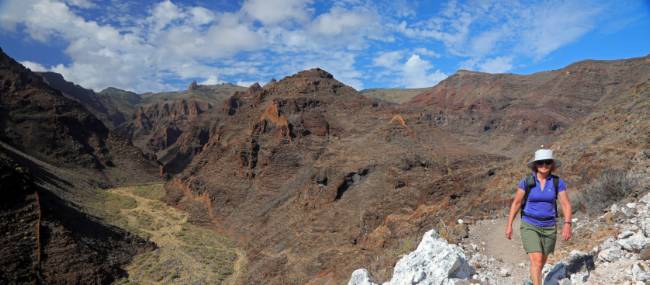
A hiker on her travels in La Gomera | John Millen
Blog home / La Gomera Highlights: 8 Things You Didn’t Know
Boasting dramatic nature and a relaxed atmosphere, La Gomera remains less known (and less developed) compared to its neighbouring Canary Islands. Travel on foot in La Gomera and you may discover highlights you had never considered before.
Below, find 8 things you didn't know about
La Gomera, but that make the Spanish island a true hidden gem for a walking holiday. Before you travel, find out how to get there and
what the weather is like, to the
unique flavours you can try and why the
strange whistles you may hear on the island are, in fact, not strange at all.
1. La Gomera is easier to travel to than you may think
Although there are no direct flights to La Gomera from anywhere in mainland Europe, the island is easily accessible from neighbouring Tenerife. Most flights arrive at Tenerife South airport, which is a short 15-minute drive from Los Cristianos port. There are sailings throughout the day and you can be in La Gomera in just less than an hour!
The extinct Guanches people developed the whistling language of Silbo Gomero as a way to communicate across the mountainous, over a distance of up to 5 km/3 miles. It uses just six condensed sounds, which replace all 26 letters of the Spanish alphabet, and has been recognised by UNESCO as a Masterpiece of the Oral and Intangible Heritage of Humanity.
3. You may eat a fish whose name doesn’t have an English translation
As you would expect from a place that is surrounded by the Atlantic Ocean, fish is widely used in Gomeran cuisine and you can have it either fresh or salted. The one dish to try on your travels to La Gomera is called ‘sancocho'. It is a traditional fish stew made from salted sea bream, stone bass or ‘cherne’ which, although it loosely translates as wreckfish, is a species that has no English equivalent.
4. ‘Palm honey’ is now unique to La Gomera
Guarapo is essentially the sap taken from the countless palm trees dotted around the island, which is cooked to make the so-called ‘palm honey’. It is used to give food a sweet taste, make desserts or mix with different drinks and juices. It’s a 500-year old tradition and, although its extraction used to take place across all Canary Islands, over time the practice was abandoned… except for La Gomera.
5. La Gomera’s most iconic festival takes place only every five years
The celebration of 'La Virgen Embarcada' sees the patron saint of the island, the Virgin of Guadalupe, taken on a sea tour. Fishermen on the island carry the icon of the Virgin on their decorated boats from Puntallana, in the north of La Gomera, to capital San Sebastian. The festival starts in October and continues for several weeks until well into December, after ‘Virgen’ has crossed all municipalities of the island.
6. La Gomera is home to a unique misty forest
As you make your way to Garajonay, the island’s highest mountain, you will find yourself walking through the thick mist of La Gomera’s unique ‘laurisliva’ cloud forest. It's a true highlight on our walking holidays. The laurel forest is full of gnarled tree roots and branches, small streams and waterfalls, and sunlight often struggles to make its way through the canopy of trees. The locals refer to the area as ‘Cedar Forest’… even though there are no cedar trees around!
7. The first sugarcane to reach the New World came from La Gomera
The port of San Sebastian was Columbus’ last stop on his first transatlantic voyage in 1492. The explorer spent several weeks on La Gomera to restock with provisions that would prepare him for the long journey ahead. On his onward travels he brought goods which included sugarcane, a plant unknown in the Americas until then. Today you can visit the house where he stayed in La Gomera as well as the church he attended.
8. La Gomera has the ideal weather for a walking holiday
Average
temperatures in La Gomera vary by just a few degrees between winter (19°C/66°F) and summer (25°C/ 77°F). Although for most of the year you will need to protect yourself from the sun as a precaution. August is the only month that it can feel too hot for a walking holiday. Another weather-related highlight; La Gomera sees little rain, which is restricted to a few days during the winter months.