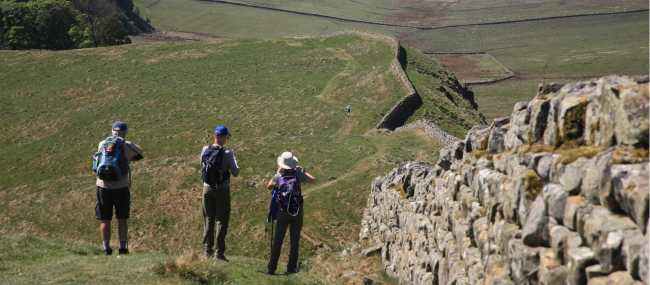
Walking the path along Hadrian's Wall | John Millen
Blog home / Walking Hadrian’s Wall, a Guide’s Favourite Locations
Walking Hadrian’s Wall, a Guide’s Favourite Locations.
After 20+ years guiding, and thousands of miles under his belt walking in the UK, when John Millen shares his perspective on a trip you can bet you’re going to get some information that only comes through experience.
Reflecting on groups he’s taken along
Hadrian’s Wall, John shares his perspective on how the 1900-year-old feature of the English landscape allows walkers to immerse themselves in history, and calls out a few of his more memorable locations along the way.
The first place the wall pops up is at Wallsend a suburb of Newcastle-upon-Tyne, often with bemused looks from walkers: ‘Where is the rest of it?’
John: Guiding a group along Hadrian's Wall can be a cathartic experience as people become more exposed and engaged in the history that surrounds them. Let’s face it, it is not every week that you can follow the same historical feature for around 80 miles and a feature which is 1900 years old. Others enjoy the walk as a kind of
Coast to Coast ‘light'.

John: People today are amazed it took such a short time. It's amazing what an emperor can do, especially without planning regulations! The northern tribes must have been an angry lot for the Romans to take all that trouble and a lot of trouble they took - three legions of some 15,000 men plus hangers on toiled for 6 years to complete the initial wall structure.

John: What I like about walking the route with a group is to see the interest in the history, not just the obvious aesthetics of the wall meandering along the undulating hills in the distance - especially between Chollerford and Greenhead, the Mithric Temple at Brocolita, Thirlwell Castle, a medieval ruin made from wall stone, or the amazing excavated communal toilets at Housesteads Fort.
There is Limestone Corner, the furthest northern point of the wall where the engineers and stonemasons gave up trying to cut the ditch because the rock hardens to volcanic Dolerite. There are a couple of blocks left idle with cut incision holes remaining on them for hitting splitting wedges into, as if the workmen had just gone on a tea break and will be coming back to finish the job.
John: My favourite place on the wall, and one which gets overlooked by probably 90% of people who walk the route are the amazingly well preserved Roman bridge abutments on the Tyne opposite Chesters Fort.
The bridge was eventually destroyed by the changing course of the river, but the stone work is amazing and there are a couple of stone columns that once graced the bridge lying about. If you trawl through the leaves, you will find a carved phallus on one of the blocks, a Roman symbol for good luck, but also another intimate connection with a workman from yesteryear.

Learn more